Dialogue Examples for a Person Seeing There Father Again
Any writer worth their salt knows that dialogue is one of the most useful tools in their arsenal: it tin provide exposition, develop your characters, and move your plot along. That's why we've put together a ready of guidelines for how to write great dialogue. Only sometimes it'southward easier to learn by example. With that in mind and to aid illustrate those rules, in this post nosotros've got some dialogue examples to show you lot them in action.
We'll be sharing xv examples of dialogue from well-known authors, and breaking down exactly why they work and so well.
1. Barbara Kingsolver, Unsheltered
In the opening of Barbara Kingsolver's Unsheltered, we meet Willa Knox, a middle-aged and newly unemployed writer who has merely inherited a ramshackle house.
"The simplest thing would be to tear information technology down," the human being said. "The house is a shambles."
She took this news as a blood-rush to the ears: a roar of peasant ancestors with rocks in their fists, facing the evictor. But this man was a contractor. Willa had called him here and she could send him away. She waited out her panic while he stood looking at her butchery, appearing to nurse some satisfaction from his diagnosis. She picked out words.
"It's not a living thing. You tin't only pronounce it expressionless. Annihilation that goes wrong with a structure tin be replaced with another structure. Am I right?"
"Correct. What I am saying is that the construction needing to exist replaced is all of it. I'm deplorable. Your foundation is nonexistent."
Alfred Hitchcock once described drama as "life with the boring bits cut out." In this passage, Kingsolver cuts out the boring parts of Willa'southward chat with her contractor and brings the states right to the tensest, well-nigh interesting part of the conversation.
Past entering their chat tardily, the reader is spared every tedious particular of their interaction.
Instead of a blow-past-blow account of their negotiations (what she needs done, when he's complimentary, how she'll be paying), we're dropped correct into the emotional heart of the give-and-take. The novel opens with the narrator learning that the abode she cherishes can't be salvaged.
By starting off in the middle of (relatively obscure) dialogue, it takes a moment for the reader to orient themselves in the story and figure out who is speaking, and what they're speaking about. This disorientation near mirrors Willa's own reaction to the bad news, as her expectations for a new life in her new home are swiftly undermined.
Free form: Writing Dandy Dialogue
Your journey to becoming a master of dialogue starts here. Get started at present.
2. Jane Austen, Pride and Prejudice
In the commencement piece of dialogue in Pride and Prejudice, we meet Mr and Mrs Bennet, as Mrs Bennet attempts to draw her hubby into a conversation about neighborhood gossip.
"My love Mr. Bennet," said his lady to him i day, "take you heard that Netherfield Park is permit at last?"
Mr. Bennet replied that he had not.
"But it is," returned she; "for Mrs. Long has merely been here, and she told me all virtually information technology."
Mr. Bennet fabricated no answer.
"Practice you lot not want to know who has taken information technology?" cried his married woman impatiently.
"You lot want to tell me, and I accept no objection to hearing it."
This was invitation enough.
"Why, my dear, you must know, Mrs. Long says that Netherfield is taken by a boyfriend of large fortune from the north of England; that he came downwards on Monday in a chaise and 4 to run across the place, and was so much delighted with information technology, that he agreed with Mr. Morris immediately; that he is to take possession earlier Michaelmas, and some of his servants are to be in the house by the terminate of next week."
Austen's dialogue is always witty, subtle, and packed with character. This extract from Pride and Prejudice is a groovy case of dialogue existence used to develop grapheme relationships.
We instantly larn everything we demand to know about the dynamic between Mr and Mrs Bennet's from their first interaction: she's communicative, and he's the beleaguered listener who has learned to entertain her idle gossip, if only for his own sake (hence "you desire to tell me, and I have no objection to hearing it").
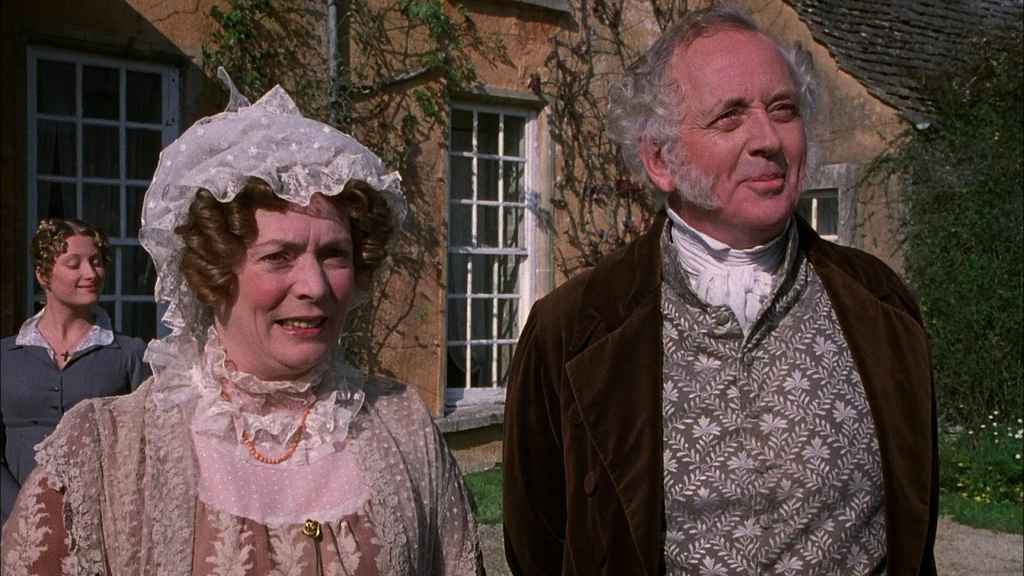
There is even a clear difference between the ii characters visually on the page: Mr Bennet responds in brusque sentences, in simple indirect speech, or non at all, but this is "invitation enough" for Mrs Bennet to launch into a rambling and extended response, dominating the conversation in text just as she does audibly.
The fact that Austen manages to imbue her dialogue with and so much graphic symbol-building realism means we inappreciably find the amount of crucial plot exposition she has packed in here. This heavily expository dialogue could exist a drag to get through, but Austen's colorful characterization means she slips it under the radar with ease, forwarding both our agreement of these people and the world they live in simultaneously.
3. Naomi Alderman, The Power
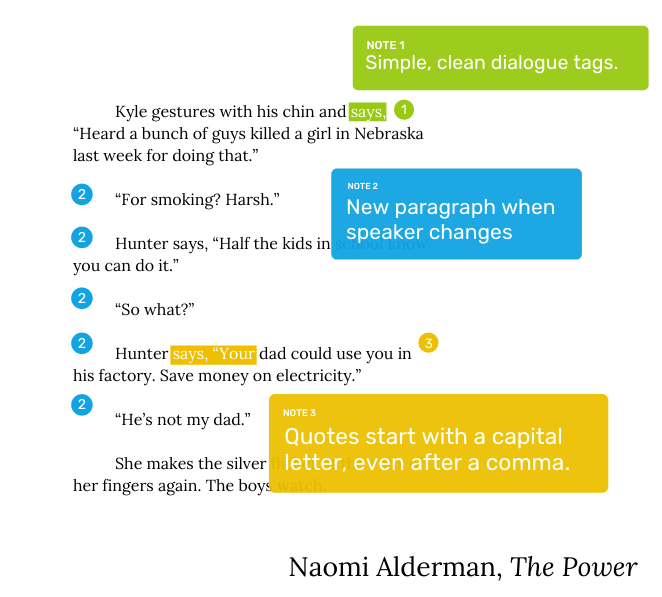
In The Ability, young women around the world suddenly find themselves capable of generating and controlling electricity. In this passage, between two boys and a daughter who only used those powers to light her cigarette.
Kyle gestures with his chin and says, "Heard a bunch of guys killed a girl in Nebraska last week for doing that."
"For smoking? Harsh."
Hunter says, "Half the kids in schoolhouse know you tin do it."
"And so what?"
Hunter says, "Your dad could employ you in his factory. Relieve money on electricity."
"He's not my dad."
She makes the argent flicker at the ends of her fingers once again. The boys watch.
Alderman here uses a show, don't tell arroyo to expositional dialogue. Within this short commutation, we discover a lot nearly Allie, her personal circumstances, and the developing situation elsewhere. We learn that women are beingness punished harshly for their powers; that Allie is expected to be ashamed of those powers and keep them a secret, only doesn't seem to care to exercise then; that her begetter is successful in industry; and that she has a difficult relationship with him. Using dialogue in this manner prevents info-dumping backstory all at once, and instead helps united states learn nigh the novel'southward world in a natural manner.
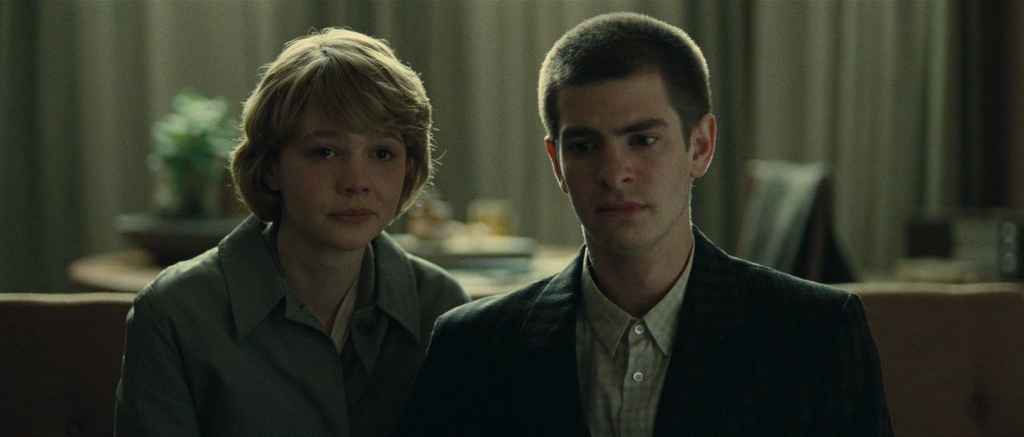
four. Kazuo Ishiguro, Never Allow Me Get
Here, friends Tommy and Kathy have a chat after Tommy has had a meltdown. Afterward being bullied by a group of boys, he has been stomping around in the mud, the precise reaction they were hoping to evoke from him.
"Tommy," I said, quite sternly. "There's mud all over your shirt."
"So what?" he mumbled. But even every bit he said this, he looked down and noticed the brown specks, and only just stopped himself crying out in alarm. And then I saw the surprise annals on his face that I should know virtually his feelings for the polo shirt.
"It's nothing to worry about." I said, before the silence got humiliating for him. "It'll come up off. If you tin can't become it off yourself, only take it to Miss Jody."
He went on examining his shirt, then said grumpily, "It's nothing to exercise with you anyway."
This episode from Never Permit Me Go highlights the ability of interspersing action beats within dialogue. These action beats work in several means to add together depth to what would otherwise be a very simple and adequately nondescript substitution. Firstly, they draw attending to the polo shirt, and highlight its potential significance in the plot. Secondly, they help to further define Kathy's human relationship with Tommy.
We learn through Tommy's surprised reaction that he didn't think Kathy knew how much he loved his seemingly generic polo shirt. This moment of recognition allows us to see that she cares for him and understands him more deeply than even he realized. Kathy breaking the silence before it tin can "humiliate" Tommy further emphasizes her consideration for him. While the dialogue alone might make us think Kathy is downplaying his concerns with pragmatic advice, it is the action beats that tell the true story here.
v. J R R Tolkien, The Hobbit
The eponymous hobbit Bilbo is engaged in a game of riddles with the strange beast Gollum.
"What take I got in my pocket?" he said aloud. He was talking to himself, just Gollum idea information technology was a riddle, and he was frightfully upset.
"Non fair! not fair!" he hissed. "It isn't fair, my precious, is information technology, to ask the states what it's got in its nassty little pocketses?"
Bilbo seeing what had happened and having naught better to ask stuck to his question. "What have I got in my pocket?" he said louder. "Due south-s-southward-s-s," hissed Gollum. "Information technology must give us three guesseses, my precious, three guesseses."
"Very well! Guess away!" said Bilbo.
"Handses!" said Gollum.
"Wrong," said Bilbo, who had luckily just taken his manus out once more. "Gauge again!"
"S-s-south-south-s," said Gollum, more upset than ever.
Tolkein's dialogue for Gollum is a masterclass in creating singled-out character voices. By using a repeated catchphrase ("my precious") and unconventional spelling and grammar to reverberate his unusual speech communication pattern, Tolkein creates idiosyncratic, unique (and iconic) spoken language for Gollum. This brilliant approach to formatting dialogue, which is almost a transliteration of the sounds Gollum makes, allows readers to imagine his spoken language pattern and practically hear it aloud.
We wouldn't recommend using this extreme level of idiosyncrasy too often in your writing — information technology can become wearing for readers after a while, and Tolkien deploys it sparingly, as Gollum'due south appearances are express to a handful of scenes. However, you lot can apply Tolkien's approach as inspiration to create (slightly more subtle) quirks of speech for your ain characters.
half dozen. F Scott Fitzgerald, The Keen Gatsby
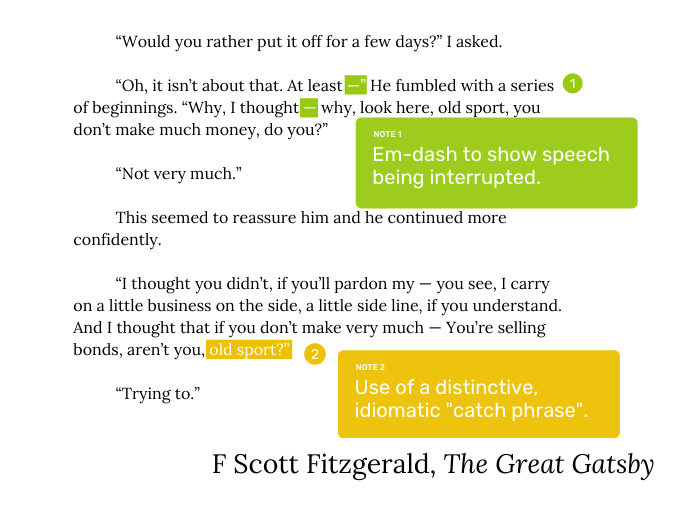
The narrator Nick has just done his new neighbor Gatsby a favor by inviting his dear Daisy over to tea. Peradventure in return, Gatsby then attempts to make a shady business proposition.
"In that location's another niggling thing," he said uncertainly, and hesitated.
"Would yous rather put it off for a few days?" I asked.
"Oh, it isn't about that. At least —" He fumbled with a serial of beginnings. "Why, I thought — why, look here, old sport, you lot don't make much money, do y'all?"
"Not very much."
This seemed to reassure him and he continued more confidently.
"I idea y'all didn't, if you'll pardon my — y'all see, I carry on a little concern on the side, a little side line, if you sympathise. And I thought that if you don't make very much — You're selling bonds, aren't you, former sport?"
"Trying to."
This dialogue from The Great Gatsby is a smashing example of how to make dialogue sound natural. Gatsby tripping over his own words (even interrupting himself, as marked by the em-dashes) not only makes his nerves and awkwardness palpable, merely also mimics existent speech. Merely every bit real people often falter and make simulated starts when they're speaking off the cuff, Gatsby also flounders, giving us insight into his self-incertitude; his voice communication isn't polished and perfect, and neither is he despite all his efforts to appear and then.
Fitzgerald too creates a distinctive voice for Gatsby by littering his speech with the character'south signature term of endearment, "old sport". We don't even really need dialogue markers to know who's speaking here — a sign of very strong label through dialogue.
vii. Arthur Conan Doyle, A Study in Crimson
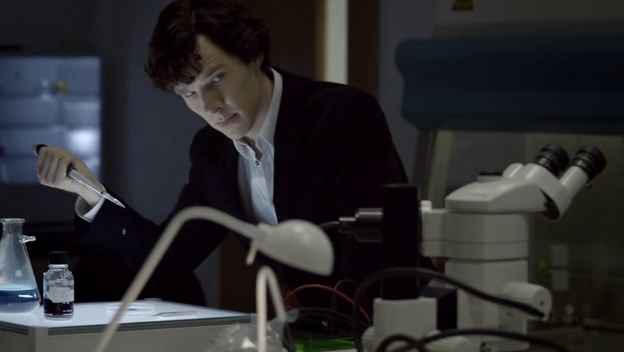
In this first meeting between the two heroes of Conan Doyle'southward Sherlock Holmes stories, Sherlock Holmes and John Watson, John is introduced to Sherlock while the latter is hard at work in the lab.
"How are you lot?" he said cordially, gripping my hand with a strength for which I should hardly have given him credit. "Y'all have been in Afghanistan, I perceive."
"How on world did you know that?" I asked in astonishment.
"Never mind," said he, chuckling to himself. "The question now is near hemoglobin. No doubt you see the significance of this discovery of mine?"
"It is interesting, chemically, no doubt," I answered, "merely practically— "
"Why, man, it is the most practical medico-legal discovery for years. Don't you see that it gives us an infallible test for blood stains. Come up over hither now!" He seized me by the coat-sleeve in his eagerness, and drew me over to the tabular array at which he had been working. "Permit u.s. have some fresh claret," he said, digging a long bodkin into his finger, and drawing off the resulting driblet of blood in a chemic pipette. "Now, I add this small quantity of blood to a litre of water. You perceive that the resulting mixture has the appearance of pure water. The proportion of claret cannot exist more than than one in a one thousand thousand. I have no incertitude, withal, that we shall exist able to obtain the characteristic reaction." As he spoke, he threw into the vessel a few white crystals, then added some drops of a transparent fluid. In an instant the contents causeless a dull mahogany colour, and a brownish dust was precipitated to the bottom of the drinking glass jar.
"Ha! ha!" he cried, clapping his easily, and looking as delighted every bit a child with a new toy. "What do you call back of that?"
This passage uses a number of the key techniques for writing naturalistic and heady dialogue, including characters speaking over i another, and the interspersal of action beats.
Sherlock cutting off Watson to launch into a monologue about his claret experiment shows immediately where Sherlock's interest lies — not in small-scale talk, or the person he is speaking to, merely in his own pursuits, just like before in the conversation when he refuses to explain annihilation to John and is instead self-absorbedly "chuckling to himself". This helps establish their initial rapport (or lack thereof) very chop-chop.
Breaking up that monologue with snippets of him undertaking the forensic tests allows us to experience the full force of his enthusiasm over it without having to read an uninterrupted spoken language near the ins and outs of a science experiment.
Starting to think yous might like to read some Sherlock? Check out our guide to the Sherlock Holmes canon !
8. Brandon Taylor, Real Life
Hither, our protagonist Wallace is questioned by Ramon, a friend-of-a-friend, over the fact that he is because leaving his PhD program.
Wallace hums. "I mean, I wouldn't say that I desire to leave, just I've thought almost it, sure."
"Why would you do that? I hateful, the prospects for… blackness people, you know?"
"What are the prospects for black people?" Wallace asks, though he knows he will be considered the aggressor for this question.
Brandon Taylor's Real Life is drawn from the writer's ain experiences as a queer Blackness human being, attempting to navigate the unwelcoming world of academia, navigating the world of academia, and so it's no surprise that his dialogue rings and then true to life — information technology's one of the reasons the novel is one of our picks for must-read books past Blackness authors.
This episode is office of a pattern where Wallace is casually cornered and questioned past people who never question for a moment whether they have the right to ambush him or criticise his choices. The utilize of indirect dialogue at the end shows united states of america this is a well-trodden path for Wallace: he has had this same conversation several times, and can pre-empt the exact outcome.
This scene is also a bang-up example of the dramatic significance of people choosing not to speak. The exchange happens in front end of a big grouping, but — despite their apparent discomfort — nobody speaks up to defend Wallace, or to criticize Ramon's patronizing microaggressions. Their silence is deafening, and we go a glimpse of Ramon's isolation due to the self-approbation of others, all due to what is not said in this dialogue example.
9. Ernest Hemingway, Hills Like White Elephants
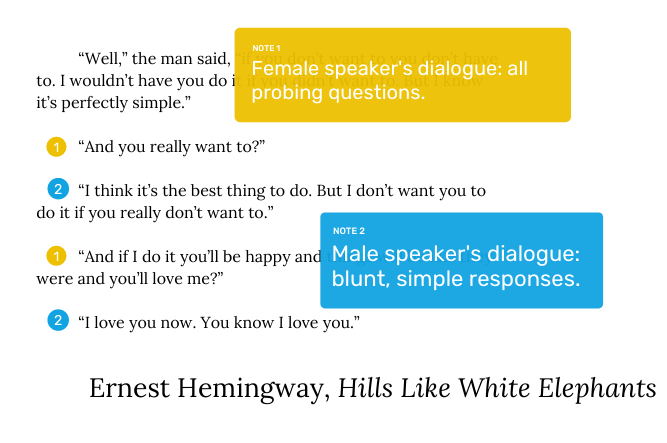
In this curt story, an unnamed homo and a young adult female discuss whether or non they should finish a pregnancy, while sitting on a train platform.
"Well," the man said, "if you don't want to yous don't take to. I wouldn't have yous practise information technology if you didn't desire to. But I know information technology'south perfectly elementary."
"And you actually desire to?"
"I think it'southward the best thing to exercise. But I don't want you to practise it if you actually don't want to."
"And if I do it you'll be happy and things will exist like they were and you'll love me?"
"I love you now. You know I love you."
"I know. But if I practice information technology, and then it will be squeamish again if I say things are like white elephants, and you'll like information technology?"
"I'll love it. I love it now but I just can't call up about it. You know how I get when I worry."
"If I exercise information technology yous won't e'er worry?"
"I won't worry almost that because it's perfectly simple."
This example of dialogue from Hemingway's curt story Hills Similar White Elephants moves at quite a clip. The conversation quickly bounces back and forth betwixt the speakers, and the phone call-and-response format of the woman asking and the man answering is effective because it establishes a clear dynamic between the 2 speakers: the woman is the one seeking reassurance and trying to empathize the man'due south feelings, while he is the ane who is ultimately in control of the situation.
Note the sparing use of dialogue markers: this minimalist arroyo keeps the dialogue brisk, and we can all the same easily sympathise who is who due to the use of a new paragraph when the speaker changes.
Like this classic author's style? Head over to our choice of the eleven best Ernest Hemingway books .
10. Madeline Miller, Circe
In Madeline Miller's retelling of Greek myth, we witness a conversation betwixt the mythical enchantress Circe and Telemachus (son of Odysseus).
"You exercise not grieve for your father?"
"I practise. I grieve that I never met the begetter anybody told me I had."
I narrowed my eyes. "Explain.""I am no storyteller."
"I am non asking for a story. You have come to my isle. You owe me truth."A moment passed, and so he nodded. "You will have it."
This brusk and punchy commutation hits on a lot of the stylistic points we've covered so far. The conversation is a taut lawn tennis lucifer between the two speakers, as they volley back and forth with short but impactful sentences, and unnecessary dialogue tags have been shaved off. Information technology also highlights Circe'due south imperious mental attitude, a result of her divine status. Her utilise of brusk, snappy declaratives and imperatives demonstrates that she'southward used to getting her own way, and feels no need to mince her words.
11. Andre Aciman, Call Me By Your Name
This is an early chat between seventeen twelvemonth sometime Elio and his family's handsome new educatee lodger, Oliver.
What did one do around here? Nothing. Look for summertime to end. What did one do in the winter, so?
I smiled at the reply I was nigh to give. He got the gist and said, "Don't tell me: await for summer to come, correct?"
I liked having my mind read. He'd selection up on dinner drudgery sooner than those before him.
"Actually, in the winter the identify gets very gray and dark. We come up for Christmas. Otherwise it's a ghost boondocks."
"And what else do you do here at Christmas besides roast chestnuts and drink eggnog?"
He was teasing. I offered the same grin equally before. He understood, said zip, we laughed.
He asked what I did. I played lawn tennis. Swam. Went out at night. Jogged. Transcribed music. Read.
He said he jogged too. Early in the forenoon. Where did one jog effectually here? Forth the promenade, more often than not. I could show him if he wanted.
It hit me in the face just when I was starting to like him again: "Afterwards, maybe."
Dialogue is one of the nearly crucial aspects of writing romance — what's a literary human relationship without some flirty lines? Here, still, Aciman gives us a great example of efficient dialogue. By removing unnecessary dialogue and instead summarizing with narration, he's able to confer the gist of the conversation without slowing downward the step unnecessarily. Instead, the emphasis is left on what's implied, the developing romantic subtext.
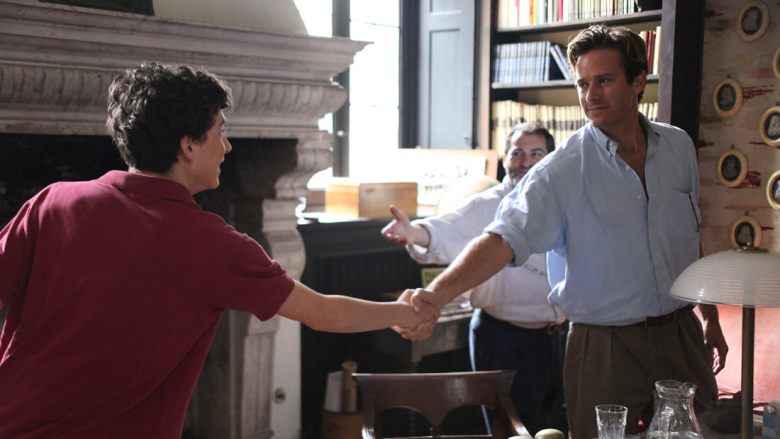
Furthermore, the fact that we receive this scene in half-reported snippets rather than as an uninterrupted transcript emphasizes the fact that this is Elio's own recollection of the story, equally the manipulation of the dialogue in this way serves to mimic the nostalgic haziness of memory.
12. George Eliot, Middlemarch
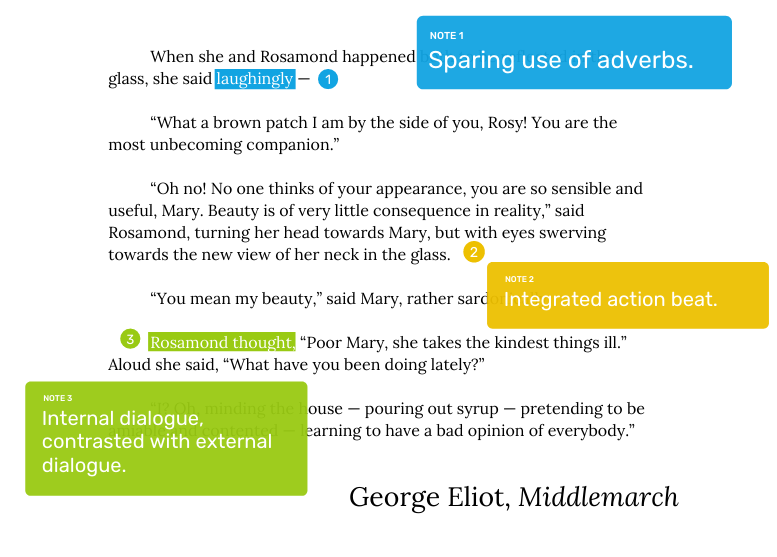
Ii of Eliot's characters, Mary and Rosamond, are out shopping,
When she and Rosamond happened both to be reflected in the drinking glass, she said laughingly —
"What a dark-brown patch I am by the side of you, Rosy! You are the nearly unbecoming companion."
"Oh no! No ane thinks of your appearance, you are so sensible and useful, Mary. Dazzler is of very little consequence in reality," said Rosamond, turning her head towards Mary, but with eyes swerving towards the new view of her cervix in the drinking glass.
"Yous mean my beauty," said Mary, rather sardonically.
Rosamond thought, "Poor Mary, she takes the kindest things sick." Aloud she said, "What have you been doing lately?"
"I? Oh, minding the house — pouring out syrup — pretending to be amiable and contented — learning to have a bad opinion of everybody."
This excerpt, a conversation between the level-headed Mary and vain Rosamond, is an case of dialogue that develops grapheme relationships naturally. The utilise of action descriptors allows the states to understand what is really happening in the conversation.
Whilst the speech alone might pb usa to believe Rosamond is honestly (if clumsily) engaging with her friend, the clarification of her simultaneously gazing at herself in a mirror gives us insight not only into her vanity, just also into the fact that she is not really engaged in her conversation with Mary at all.
The use of internal dialogue cut into the conversation (here formatted with quotation marks rather than the usual italics) lets the states know what Rosamond is actually thinking, and the contrast between this and what she says aloud is telling. The fact that we know she privately realizes she has offended Mary, but quickly continues the chat rather than apologizing, is emphatic of her graphic symbol. We go to know Rosamond very well within this short passage, which is a hallmark of constructive grapheme-driven dialogue.
thirteen. John Steinbeck, The Winter of our Discontent
Here, Mary (speaking first) reacts to her husband Ethan's attempts to discuss his previous experiences as a disciplined soldier, his struggles in subsequent life, and his feeling of impending modify.
"You're trying to tell me something."
"Sadly enough, I am. And it sounds in my ears like an apology. I hope it is not."
"I'1000 going to set out luncheon."
Steinbeck's Winter of our Discontent is an acute report in alienation and miscommunication, and this exchange exemplifies the ways in which characters can fail to communicate, even when they're speaking. The pair speaking hither are trapped in a dysfunctional wedlock which leaves Ethan feeling isolated, and part of the loneliness he feels comes from the accumulation of exchanges such as this 1. Whenever he tries to communicate meaningfully with his wife, she shuts the conversation down with a complete non sequitur.
We expect Mary's "you're trying to tell me something" to exist followed by a revelation, merely Ethan is not forthcoming in his response, and Mary then exits the conversation entirely. Nada is communicated, and the jarring and frustrating consequence of having our expectations subverted goes a long fashion in mirroring Ethan'due south own frustration.
Just like Ethan and Mary, nosotros receive no emotional pay-off, and this passage of characters talking past one some other doesn't farther the plot every bit we promise information technology might, but instead gives u.s. insight into the extent of these characters' estrangement.
fourteen. Bret Easton Ellis, Less Than Zero
The disillusioned master character of Bret Easton Ellis' debut novel, Dirt, here catches up with a college friend, Daniel, whom he hasn't seen in a while.
He keeps rubbing his rima oris and when I realize that he's non going to answer me, I enquire him what he's been doing.
"Been doing?"
"Yeah."
"Hanging out."
"Hanging out where?"
"Where? Around."
Less Than Zero is an elegy to chat, and this dialogue is an example of the many vacuous exchanges the protagonist engages in, seemingly only to fill time. The whole volume is deliberately unpoetic and flat, and depicts the lives of disaffected youths in 1980s LA. Their misguided attempts to fill the emptiness within them with drink and drugs are ultimately fruitless, and it shows in their conversations: in truth, they have zip to say to one other at all.
This utterly meaningless exchange would elsewhere be considered dead weight to a story. Here, rather than being fat in need of trimming, the empty conversation is instead thematically resonant.
15. Daphne du Maurier, Rebecca
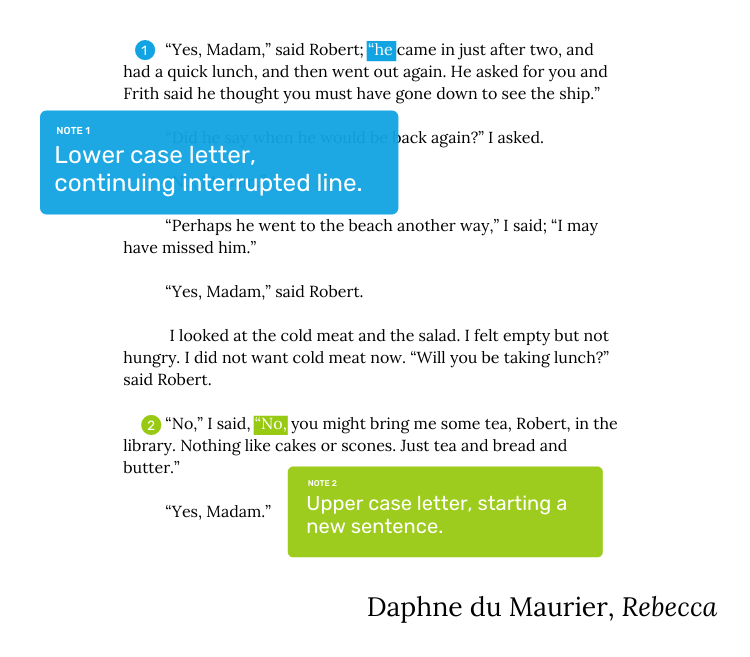
The young narrator of du Maurier's classic gothic novel here has a strained conversation with Robert, i of the young members of staff at her new husband's domicile, the unwelcoming Manderley.
"Has Mr. de Winter been in?" I said.
"Yes, Madam," said Robert; "he came in just after two, and had a quick lunch, and then went out again. He asked for you and Frith said he thought you must have gone downward to see the ship."
"Did he say when he would be back again?" I asked.
"No, Madam."
"Perhaps he went to the beach some other mode," I said; "I may accept missed him."
"Yes, Madam," said Robert.
I looked at the cold meat and the salad. I felt empty but not hungry. I did not want common cold meat now. "Will you be taking tiffin?" said Robert.
"No," I said, "No, yous might bring me some tea, Robert, in the library. Nada like cakes or scones. Only tea and bread and butter."
"Yeah, Madam."
The reason we're including this one in our dialogue examples list is to show you lot the power of everything Du Maurier doesn't practise: rather than cycling through a ton of fancy synonyms for "said", she opts for spare dialogue and tags.
The cold, sparse tone in this interaction complements the lack of warmth the protagonist is feeling in the moment depicted here. By keeping the dialogue tags simple, the author ratchets upwardly the tension — without any distracting flourishes taking the reader out of the scene. The subtext of the conversation is able to simmer under the surface, and we aren't beaten over the caput with any stage management extras.
The inclusion of three sentences of internal dialogue in the middle of the dialogue ("I looked at the cold meat and the salad. I felt empty but not hungry. I did not want cold meat at present.") is also a masterful touch. What could take been a single judgement is stretched into three, creating a massive meaning break earlier Robert continues speaking, without having to explicitly signpost one. Manipulating the stride of dialogue in this way and manufacturing meaningful silence is a great manner of adding depth to a scene.
Phew! We've been through a lot of dialogue, from offset meetings to idle chit chat to confrontations, and nosotros hope these dialogue examples have been helpful in illustrating some of the well-nigh common techniques.
If you're looking for more pointers on how to create conceivable and effective dialogue, be certain to check out our form on writing dialogue. Or, if yous find you acquire ameliorate through examples, y'all can take a look at our list of 100 books to read before you die — information technology's packed full of proficient storytellers who've really honed the art of dialogue.
Source: https://blog.reedsy.com/guide/how-to-write-dialogue/dialogue-examples/
0 Response to "Dialogue Examples for a Person Seeing There Father Again"
Post a Comment